Why Claude Is Becoming the AI Model Professionals Actually Trust
The AI Race Has a Clear Front-Runner Right Now
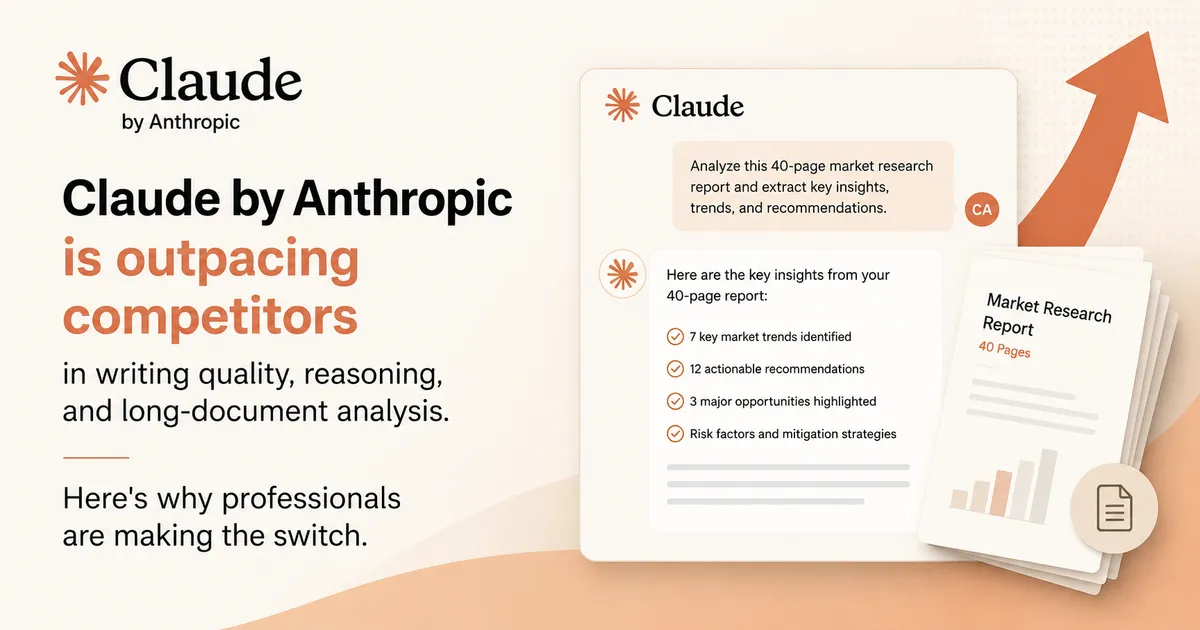
There's no shortage of AI models competing for attention. OpenAI, Google, Meta, Mistral — the list keeps growing. But over the past year, one name has quietly moved to the top of serious users' tool stacks: Claude by Anthropic.
This isn't just hype. Developers, writers, researchers, and product teams are switching — and staying. The reasons go deeper than benchmark scores or marketing.
Here's what's actually driving Claude's rise.
🧠 Built on a Philosophy, Not Just Parameters
Most AI companies lead with performance numbers. Anthropic leads with a research methodology called Constitutional AI (CAI) — a framework that trains Claude to be helpful, harmless, and honest at the same time.
This matters more than it sounds. Many models are helpful in ways that feel hollow — they'll agree with anything, hallucinate confidently, or avoid hard questions entirely. Claude was designed to push back when it should, admit uncertainty honestly, and engage with nuance.
That philosophical foundation changes how the model actually behaves in real-world use.
🚀 Context Window That Changes What's Possible
One of Claude's most practical advantages is its 200,000-token context window — far beyond what most models offered when it launched.
What does that mean in practice?
Uploading an entire codebase and asking for refactor suggestions
Dropping a 300-page PDF and having a real conversation about it
Maintaining consistent logic across extremely long documents
This isn't a marginal improvement. It fundamentally changes the kind of work AI can assist with. Tasks that required chunking documents, losing thread, and stitching outputs back together can now happen in a single session.
A 200K token context window isn't just a feature — it's a different category of tool for knowledge-intensive work.
📌 Common Complaints About Other AI Models (That Claude Largely Avoids)
If you've used GPT-4 or Gemini extensively, you've probably run into a few recurring frustrations:
Sycophantic responses — agreeing with whatever you say, even when you're wrong
Confident hallucinations — stating false information with zero hesitation
Refusal overcorrection — refusing reasonable requests due to overly cautious safety filters
Losing context in long conversations
Claude handles these noticeably better. It will tell you when your logic has a gap. It flags uncertainty rather than bluffing. It handles nuanced, sensitive, or complex topics without reflexively refusing. And its long context window means it holds the thread better across extended sessions.
💡 Writing and Reasoning Quality That Stands Apart
Claude consistently ranks at the top for two things that matter most to professionals: writing quality and structured reasoning.
The writing feels less robotic. Sentences vary naturally. Explanations don't follow a template. When you ask it to write something in a specific voice or adapt to a style, it actually does — instead of producing generic filler dressed up with synonyms.
On reasoning, Claude handles multi-step logic problems, ambiguous scenarios, and analytical tasks with more consistency than most models. It's not perfect, but the failure modes are more predictable and recoverable.
For developers, this translates to cleaner code explanations. For writers, it means better collaborative drafts. For analysts, it means more trustworthy summaries.
🔑 The Safety Advantage Is Also a Product Advantage
Anthropic's safety research isn't separate from Claude's usefulness — it's baked into the product quality.
Because Claude was trained with careful attention to honesty and alignment, it tends to:
Cite limitations rather than mask them
Give calibrated confidence instead of overconfident answers
Handle ethically complex topics with genuine nuance
For enterprise teams and regulated industries, this matters significantly. Deploying an AI that confidently hallucinates legal or medical information is a liability. Claude's tendency toward honest uncertainty is, counterintuitively, what makes it more reliable.
Safety-focused training doesn't make Claude less capable — it makes it more trustworthy in high-stakes professional environments.
🛠️ Claude in Workflows: Where It Performs Best
Claude isn't equally suited to everything, but it excels in a specific set of high-value use cases:
Long-document analysis — research papers, contracts, reports
Technical writing and documentation — clean, well-structured outputs
Complex Q&A — multi-part questions with nuanced answers
Code review and debugging — especially with large context
Strategic thinking — outlining plans, analyzing tradeoffs, questioning assumptions
Content creation — articles, scripts, copy that reads naturally
For quick, simple tasks, most models perform similarly. Claude's advantage compounds on harder, longer, more complex work.
📊 How Claude Stacks Up Against the Competition
Capability | Claude 3.7 | GPT-4o | Gemini 1.5 Pro |
|---|---|---|---|
Context Window | 200K tokens | 128K tokens | 1M tokens |
Writing Naturalness | ⭐⭐⭐⭐⭐ | ⭐⭐⭐⭐ | ⭐⭐⭐ |
Reasoning Depth | ⭐⭐⭐⭐⭐ | ⭐⭐⭐⭐⭐ | ⭐⭐⭐⭐ |
Honesty / Calibration | ⭐⭐⭐⭐⭐ | ⭐⭐⭐ | ⭐⭐⭐ |
Refusal Overcorrection | Low | Medium | Medium |
Enterprise Safety | High | High | Medium |
Note: Benchmarks vary by task type. These reflect general professional-use assessments.
🔍 What Anthropic Is Doing Differently at the Research Level
Anthropic was founded by former OpenAI researchers — people who left specifically because they wanted to prioritize AI safety as a core engineering concern, not an afterthought.
Their research into interpretability (understanding what's happening inside the model), constitutional AI, and alignment is published openly and taken seriously by the broader ML community.
This research culture has a direct impact on the product. When something goes wrong with Claude, the team has better tools to understand why and fix it at the root — not just patch outputs.
❓ FAQs
Is Claude better than ChatGPT for professional use? For knowledge-intensive, long-form, or nuanced tasks, most professionals find Claude more reliable. ChatGPT has a wider range of integrations and plugins, but Claude tends to produce more honest and naturally-written outputs.
Does Claude hallucinate less than other models? Claude is generally more calibrated — it's more likely to say "I'm not sure" than to confidently state something false. It still makes errors, but the failure mode is more transparent.
Can Claude handle very long documents? Yes. With a 200K token context window, Claude can process books, large codebases, or lengthy reports in a single session — something most competitors struggle with at scale.
Is Claude available for businesses and developers? Yes. Claude is accessible via the Claude.ai interface, the Anthropic API, and through tools like Claude Code for developers. Enterprise plans with additional privacy and compliance features are also available.
Why do people say Claude feels more "human" than other AIs? It comes down to writing style, calibrated honesty, and willingness to engage with complexity without deflecting. Claude was trained on how thoughtful people reason and communicate — not just how to produce technically correct outputs.
💡 Final Thoughts
The AI landscape is crowded, and every major model has real strengths. But Claude stands out for reasons that compound over time: honest answers, genuinely high writing quality, massive context handling, and a safety-first engineering culture that produces more reliable behavior in real-world use.
For casual use, any model might do the job. For serious, high-stakes, or complex professional work — Claude has built a strong case for being the most trustworthy tool in the room.
The best AI model isn't always the one with the highest benchmark score — it's the one you can actually rely on when the work matters.

The above article is written by me, a person interested in technology, automobiles, modern gadgets, movies, music, and clean aesthetics.