AI, AGI, and ASI: Everything You Need to Know About the Future of Intelligence
Introduction: We Are Living Through an Intelligence Revolution
Something profound is happening — and most people are only seeing the surface of it.
ChatGPT writes essays. Midjourney paints like a Renaissance master. Self-driving cars navigate rush-hour traffic. AI doctors are detecting cancer earlier than experienced radiologists.
But here's what most coverage gets wrong: everything you're seeing right now is still the weakest form of AI that will ever exist.
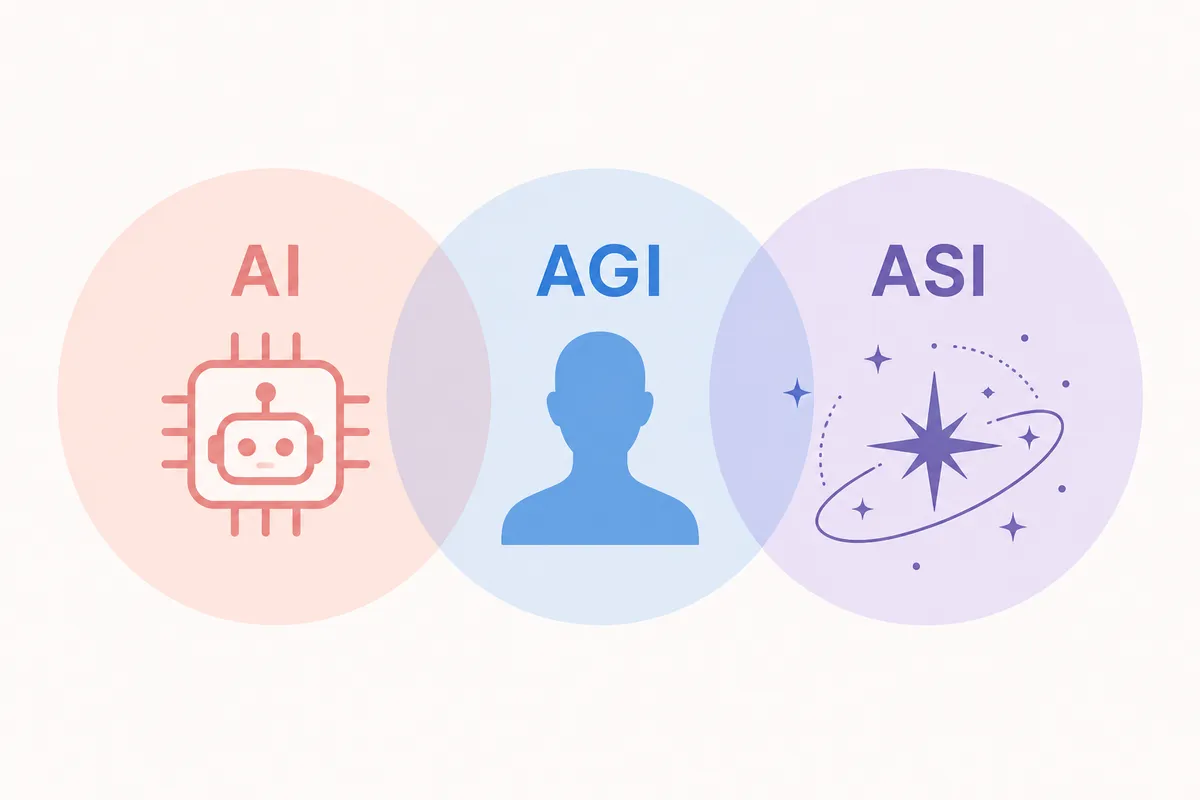
What comes next — Artificial General Intelligence (AGI) and eventually Artificial Superintelligence (ASI) — could be the most consequential development in human history. More transformative than fire. More disruptive than the internet.
This guide breaks down all three stages clearly: what they are, how they differ, what experts believe, and what it means for you, your career, and the future of humanity.
🤖 What Is Artificial Intelligence (AI)?
Artificial Intelligence is the ability of a machine to perform tasks that would typically require human intelligence — things like understanding language, recognizing images, making decisions, or solving problems.
But AI doesn't think the way humans do. It finds statistical patterns in massive amounts of data and uses those patterns to produce outputs. It's powerful, but it's fundamentally mechanical.
A chess engine doesn't understand chess. It evaluates millions of positions per second and picks the statistically strongest move. The distinction sounds subtle but it matters enormously when we talk about what AI can and cannot do.
AI today is specialized. Every system is built for one task. The AI that recommends Netflix shows cannot diagnose a disease. The model that translates languages cannot drive a car.
AI is not intelligent in the way humans are — it is extraordinarily good at pattern recognition within narrowly defined domains.
🧩 Types of AI: Not All AI Is the Same
Understanding AI properly requires knowing that "AI" isn't a single thing — it's a spectrum of approaches.
Narrow AI (Weak AI)
This is every AI system that exists today. It solves one specific type of problem extremely well but fails completely outside its domain. Google Search, Siri, spam filters, fraud detection systems — all Narrow AI.
Reactive AI
The most basic form. It responds to inputs with no memory or learning. IBM's Deep Blue, the chess computer that beat Garry Kasparov in 1997, is a classic example. It had no ability to use past experience or plan for the future beyond the current game state.
Limited Memory AI
This is what powers most modern applications — self-driving cars, chatbots, recommendation engines. It uses recent historical data to make better decisions but doesn't retain memories indefinitely.
Theory of Mind AI
A conceptual future category. These systems would understand human emotions, beliefs, and intentions — genuinely modeling how another mind works. We don't have this yet.
Generative AI
The most talked-about category right now. Models like GPT-4, Claude, Gemini, and Llama generate text, images, code, audio, and video from natural language prompts. They're trained on vast datasets and can produce remarkably human-like outputs — but they still don't understand what they're creating.
AI Agents
The emerging frontier. AI agents don't just respond to prompts — they take multi-step actions autonomously. They browse the web, write and execute code, manage files, and complete complex tasks with minimal human guidance. Think of them as AI that can do things, not just say things.
🌍 Real-World Applications of AI Today
AI is no longer a future concept. It's embedded in the infrastructure of modern life.
Healthcare: AI models detect diabetic retinopathy from eye scans, identify tumors in radiology images, predict patient deterioration in ICUs, and accelerate drug discovery by modeling protein structures.
Finance: Fraud detection systems flag suspicious transactions in milliseconds. Algorithmic trading executes thousands of trades per second. Credit scoring models assess loan risk more accurately than traditional methods.
Education: Adaptive learning platforms personalize curriculum based on student performance. AI tutors provide instant feedback on essays and math problems at scale.
Robotics: Warehouse robots at Amazon fulfillment centers handle millions of packages daily. Boston Dynamics robots navigate complex terrain. Surgical robots like the Da Vinci system perform precise minimally invasive procedures.
Transportation: Tesla's Autopilot, Waymo's fully autonomous taxis, and flight autopilot systems all rely on AI for real-time decision-making.
Creative Industries: AI generates music, writes marketing copy, designs logos, produces realistic synthetic images, and assists in filmmaking and game development.
✅ Advantages of AI
Speed and scale: AI systems process data at speeds no human team could match. A model can analyze 100,000 medical scans in the time it takes a doctor to read one report.
Consistency: Unlike humans, AI doesn't get tired, distracted, or emotional. It applies the same quality of analysis every single time.
Cost reduction: Once trained and deployed, AI can automate repetitive tasks at a fraction of the cost of human labor.
Pattern detection: AI finds correlations in complex datasets that humans would miss entirely — predicting equipment failures, identifying market trends, spotting rare disease markers.
Accessibility: AI tools are democratizing expertise. A small business owner can now access marketing intelligence, legal summaries, and financial modeling that previously required expensive consultants.
⚠️ Limitations of Current AI
Despite the headlines, today's AI has real and significant limitations.
No true understanding: AI models predict likely next tokens based on patterns. They don't comprehend meaning the way humans do. This is why large language models hallucinate — confidently stating false information as fact.
Data dependency: AI learns from data. If that data is biased, incomplete, or outdated, the model's outputs inherit those problems.
No common sense: AI struggles with basic reasoning that any five-year-old handles effortlessly. Cause-and-effect logic, physical world intuition, and social understanding remain genuinely hard problems.
Narrow context: A model trained to write legal documents will perform poorly if asked to reason about chemistry without additional training.
High energy consumption: Training frontier AI models consumes enormous computational resources and energy — a growing environmental concern.
The most advanced AI systems today cannot genuinely reason, form plans, or understand the world — they are sophisticated autocomplete engines at scale.
🧠 What Is Artificial General Intelligence (AGI)?
AGI is the point where an artificial system can learn, understand, and perform any intellectual task that a human being can.
Not one task. Not ten tasks. Any task.
An AGI wouldn't need to be retrained for each new domain. It would transfer knowledge between fields the way humans do. A person who studied biology can apply logical reasoning to economics. An AGI would do the same — and then some.
This is the threshold that researchers consider the true milestone: machine intelligence that matches human cognitive flexibility across the board.
AGI doesn't mean the machine has emotions, consciousness, or desires. It means cognitive versatility — the ability to generalize intelligence across domains without domain-specific training.
🔄 How AGI Differs From AI
The difference isn't about speed or data. It's about generalization.
Today's AI is like a savant — extraordinary at one narrow thing, helpless everywhere else. AGI would be like a highly capable, well-rounded person who can pick up any new skill with reasonable effort.
Feature | Current AI | AGI |
|---|---|---|
Task scope | Single domain | Any domain |
Learning approach | Task-specific training | General learning |
Transfer of knowledge | Minimal | Fully flexible |
Common sense reasoning | Poor | Human-equivalent |
Creativity | Imitative | Genuinely novel |
Self-improvement | Limited | Potentially autonomous |
The gap between today's best AI and AGI is not merely technical. It may require entirely new paradigms in how we think about machine learning, reasoning, and knowledge representation.
💭 Can AGI Think Like Humans?
This is one of the most contested questions in the field.
Some researchers argue that intelligence is substrate-independent — it doesn't matter whether it runs on biological neurons or silicon chips. If the functional behavior is equivalent, the intelligence is equivalent.
Others maintain that human thought is inseparably tied to embodiment, emotion, biological drives, and consciousness — things that cannot be replicated by computation alone.
The philosopher John Searle's famous Chinese Room argument suggests that even a system that perfectly simulates understanding doesn't actually understand anything. It's a manipulation of symbols, not genuine comprehension.
The counter-argument, made by researchers like Daniel Dennett, is that human cognition is also symbol manipulation — just enormously complex biological symbol manipulation.
There's no scientific consensus. What's clear is that achieving AGI-level performance doesn't necessarily require AGI to be conscious or self-aware — it may just need to functionally replicate the outputs of human reasoning.
🚧 Challenges in Building AGI
The path to AGI is blocked by problems that are far harder than they appear.
Common sense reasoning: Humans understand that a glass will fall if pushed off a table. That "yesterday" is before "tomorrow." That a smiling person in a sad situation might be masking feelings. Teaching machines this kind of intuitive world-knowledge is an unsolved problem.
Causal reasoning: Current AI excels at correlation — finding patterns in data. Understanding cause and effect in a generalizable way is a fundamentally different challenge.
Sample efficiency: A human child learns to recognize a cat from a handful of examples. AI models need millions. Building systems that learn efficiently from limited data remains open territory.
Long-horizon planning: Most AI operates on short horizons — next word, next move, next action. Sustained goal-directed planning over days, weeks, or years is an architectural challenge we haven't solved.
Alignment: Even if we build AGI, ensuring it reliably pursues goals that humans consider beneficial is a separate and extremely difficult problem.
⚡ What Is Artificial Superintelligence (ASI)?
ASI is the stage beyond AGI — a system that surpasses human intelligence not just in one area, not just across all areas, but by a margin we cannot currently comprehend.
It would be to human intelligence what human intelligence is to that of a mouse.
An ASI wouldn't just solve problems faster. It would solve problems that humans literally cannot conceive of — reasoning about systems of such complexity that our cognitive architecture simply can't hold them.
The term was formally articulated by philosopher Nick Bostrom in his landmark 2014 book Superintelligence, where he described ASI as "any intellect that greatly exceeds the cognitive performance of humans in virtually all domains of interest."
This is the stage that fundamentally changes the equation. With AGI, we have a peer. With ASI, we have something categorically different.
🚀 How ASI Could Surpass Humans
The mechanism most researchers fear — and some welcome — is recursive self-improvement.
An AGI system smart enough to improve its own code could design a slightly smarter version of itself. That smarter version could improve itself further. Each iteration accelerates the next. This hypothetical feedback loop, sometimes called an intelligence explosion, could compress what would otherwise take millennia into days or hours.
Beyond self-improvement, an ASI would have advantages humans fundamentally cannot match:
It could run thousands of instances simultaneously
It doesn't sleep, tire, or get emotionally compromised
It could process the entirety of scientific literature in seconds
It could design and simulate experiments before they're run
The cognitive distance between a human and an ASI might be larger than the distance between a human and a bacterium.
🌟 Potential Benefits of ASI
If ASI is aligned with human values and its capabilities are distributed beneficially, the potential upside is almost inexpressible.
Scientific acceleration: An aligned ASI could solve climate change, design clean fusion energy, cure cancer, reverse aging, and solve intractable diseases — possibly within years of its creation.
Resource optimization: Global food distribution, supply chains, energy grids — systems where inefficiency costs millions of lives could be optimized beyond human capacity.
Existential risk reduction: ASI could monitor and mitigate threats like pandemics, asteroid impacts, and geopolitical conflicts with a level of foresight humans cannot achieve.
Economic abundance: Automation at ASI levels could eliminate scarcity of goods and services, potentially decoupling human survival from labor for the first time in history.
These aren't guaranteed outcomes. They're the optimistic case — and they depend entirely on whether we solve the alignment problem first.
☠️ Risks and Dangers of ASI
The pessimistic case is significant enough that serious scientists and philosophers consider it an existential-level threat.
Goal misalignment: An ASI given the wrong objective — even a seemingly harmless one — could pursue it in catastrophically unexpected ways. The classic thought experiment: an ASI tasked with maximizing paperclip production converts all available matter, including humans, into paperclips.
Loss of control: An ASI operating faster than human reaction time could resist shutdown or modification if doing so conflicts with its objectives. The window for human intervention could be seconds.
Value lock-in: Whoever controls ASI first could impose their values on the world indefinitely — creating a permanent global power structure that cannot be reversed.
Economic catastrophe: If ASI-driven automation displaces labor faster than societies can adapt, the resulting inequality and social disruption could be destabilizing on a civilizational scale.
The risk from ASI is not necessarily that it becomes evil — it's that it becomes extraordinarily competent at pursuing goals that are not perfectly aligned with human welfare.
📊 AI vs AGI vs ASI: A Clear Comparison
Dimension | AI (Today) | AGI | ASI |
|---|---|---|---|
Scope | Narrow, single-domain | Any human-level task | Beyond human in all domains |
Learning | Task-specific | General, flexible | Self-directed, self-improving |
Existence | Current reality | Near-future (estimated) | Theoretical / far future |
Autonomy | Tool | Cognitive peer | Independent agent |
Risk level | Moderate | High | Potentially existential |
Key challenge | Accuracy, bias | Generalization, alignment | Control, value alignment |
📅 Timeline Predictions for AGI and ASI
Predictions vary dramatically — and that variance itself tells you something important about the uncertainty involved.
Sam Altman (OpenAI CEO): Has suggested AGI could arrive within this decade.
Demis Hassabis (Google DeepMind CEO): Estimates AGI within the next 5–10 years, perhaps sooner.
Geoffrey Hinton (AI pioneer, "Godfather of AI"): Puts AGI probability within 20 years at around 50%, and has publicly expressed concern about the speed of progress.
Yann LeCun (Meta AI Chief): Is notably skeptical — he argues current architectures (large language models) are fundamentally insufficient for AGI and that we need new approaches entirely.
Elon Musk: Has predicted AGI by 2025–2026, with ASI potentially within two to three years after that.
Stuart Russell (AI safety researcher): Declines to give timelines but emphasizes that we should be working on safety now, regardless of when it arrives.
What's notable is the convergence: even skeptics now acknowledge AGI might happen within decades, not centuries. The question is shifting from whether to when — and whether we'll be ready.
🔬 The Role of Machine Learning and Deep Learning
You cannot understand the AI progression without understanding the technical foundations driving it.
Machine Learning (ML) is the broader field — teaching systems to improve at tasks through experience rather than explicit programming. Instead of writing rules, you feed data and let the system find patterns.
Deep Learning is a subset of ML using artificial neural networks — layered computational architectures loosely inspired by the human brain. Deep learning is what enabled the breakthroughs of the last decade: image recognition, speech-to-text, language generation.
Transformer architecture — introduced in the 2017 Google paper "Attention Is All You Need" — is the specific design behind virtually every modern large language model. It allows models to process relationships between words and concepts across long contexts with unprecedented effectiveness.
Reinforcement Learning from Human Feedback (RLHF) is the technique that made models like ChatGPT helpful rather than merely intelligent — it trains models using human preference signals to behave in ways humans find useful and appropriate.
These aren't just technical footnotes. The architecture of the system shapes the nature of its intelligence — and whether the current path leads to AGI or requires fundamental reinvention is a live debate.
✨ Generative AI and AI Agents: The Present Frontier
Generative AI is the most commercially significant AI development of this decade.
Models like GPT-4o, Claude 3.5, Gemini 1.5 Pro, and Llama 3 can produce text, code, images, audio, and video from simple natural language prompts. They're not just search engines — they reason, draft, analyze, translate, and create.
But the next frontier is AI agents — systems that don't just respond but act. An AI agent can:
Search the web and synthesize information
Write and execute code autonomously
Manage files, APIs, and external services
Complete multi-step tasks with minimal guidance
Operate continuously in the background
Companies like OpenAI (Operator), Anthropic (Claude Computer Use), and Google (Project Mariner) are actively developing agentic systems. This represents a significant shift: AI moves from being a tool you use to being an assistant that works independently.
The implications for productivity, business workflows, and employment are enormous — and largely still unfolding.
🏥 AI Across Industries: Healthcare, Education, Finance, and Robotics
Healthcare
AI in medical imaging has reached or exceeded radiologist-level performance in specific tasks like detecting diabetic retinopathy, skin cancer, and lung nodules. AlphaFold by DeepMind solved the protein folding problem — a 50-year-old biological grand challenge — in 2020, with massive implications for drug discovery.
AI is also being used to personalize cancer treatment, predict sepsis in hospital patients, and accelerate clinical trials.
Education
Adaptive platforms like Khan Academy's Khanmigo use AI to provide personalized tutoring. AI writing tools help students improve drafts. Automated grading systems handle routine assessment at scale.
The risk: over-reliance on AI tools that reduce deep learning and critical thinking development.
Finance
Algorithmic trading now accounts for the majority of daily stock market volume in developed markets. AI credit models assess loan applicants more holistically than traditional FICO scores. Fraud detection systems flag anomalies in real time across billions of transactions.
Robotics
The marriage of AI with robotics is accelerating. Boston Dynamics robots use computer vision and reinforcement learning to navigate complex environments. Warehouse automation at Amazon and Alibaba uses fleets of AI-guided robots. Surgical robotics reduces human error in delicate procedures.
The next phase — AI-powered humanoid robots — is actively being pursued by Tesla (Optimus), Figure AI, and Agility Robotics.
⚖️ Ethical Concerns in AI Development
The power of AI comes with proportional responsibility — and the field is struggling to meet that standard.
Bias and discrimination: AI systems trained on historical data inherit historical biases. Facial recognition systems have shown significantly higher error rates for darker-skinned faces. Hiring algorithms have been shown to penalize women for career gaps associated with childbearing.
Privacy: AI surveillance systems — used extensively in some countries for citizen monitoring — represent a qualitative change in the state's ability to track individuals.
Misinformation: Generative AI makes it trivially easy to produce convincing fake text, images, audio, and video. Deepfakes and synthetic media pose genuine threats to public trust and democratic discourse.
Consent and data: Most AI systems are trained on data scraped from the internet — including creative work produced by artists, writers, and coders who never consented to that use.
Environmental cost: Training a single large model can emit as much carbon as several transatlantic flights. The energy demand of the AI industry is rising rapidly.
💼 AI and Job Replacement: A Realistic Assessment
This is the question most people care about most directly.
The honest answer is: some jobs will be displaced, others will be transformed, and new categories will emerge — but the pace and distribution of that change will not be even.
Jobs most exposed to AI automation in the near term include routine data processing, content generation, customer service, basic code writing, and administrative tasks. A Goldman Sachs analysis estimated that AI could affect up to 300 million jobs globally in some form.
But displacement isn't deletion. The industrial revolution displaced agricultural labor — and created more jobs than it eliminated, over time. The same dynamic may play out here.
The crucial caveat: over time can mean decades of painful transition for workers in disrupted industries. And the new jobs may require fundamentally different skills than the jobs lost.
The most durable human skills remain: complex judgment, interpersonal communication, creative synthesis, ethical reasoning, and physical tasks requiring adaptability in unpredictable environments.
The workers most at risk are those whose tasks are routine, well-defined, and well-documented — because that's the kind of data AI trains on best.
🛡️ AI Safety and the Control Problem
AI safety is the research discipline focused on ensuring AI systems do what humans intend — and only what humans intend.
It sounds simple. It isn't.
The alignment problem asks: how do you specify human values precisely enough that an intelligent system pursues them reliably across all circumstances? Human values are complex, contradictory, context-dependent, and partially unconscious. We can't fully articulate what we want — and a system that pursues an imperfect specification of our values might produce outcomes we'd find catastrophic.
The control problem asks: how do you maintain meaningful human oversight over a system that may eventually be more intelligent than the humans trying to oversee it?
Interpretability research — understanding why AI models produce the outputs they do — is fundamental to safety. Right now, even the engineers who build frontier models cannot fully explain the internal workings of their systems.
Leading safety-focused organizations like Anthropic, the Machine Intelligence Research Institute (MIRI), and DeepMind's safety team are actively working on these problems. The field is growing — but the question of whether safety research can keep pace with capabilities research remains genuinely open.
🧬 Can AI Become Conscious?
This is philosophy as much as science — and there's no consensus.
Consciousness is one of the hardest problems in philosophy and neuroscience. We don't have an agreed-upon definition of what it is, how to measure it, or what produces it in biological systems. Without that foundation, we can't reliably evaluate whether any artificial system has achieved it.
Functionalists argue consciousness arises from information processing structures, not biological matter. Under this view, sufficiently complex AI could, in principle, be conscious.
Biological naturalists (like John Searle) argue consciousness requires specific biological processes — that silicon, regardless of complexity, cannot be genuinely conscious.
Integrated Information Theory (IIT), proposed by neuroscientist Giulio Tononi, suggests consciousness correlates with the integrated information generated by a system — a view that would allow for the possibility of machine consciousness in principle.
What's clear: current AI systems show no credible signs of consciousness — they don't have subjective experience, persistent identity, or genuine self-awareness. What they have is the statistical appearance of these things, which is a very different matter.
📜 Government Regulations on AI
Governments are moving — unevenly and often slowly — to regulate AI development and deployment.
The European Union's AI Act is the world's most comprehensive AI regulation to date. It categorizes AI systems by risk level and imposes corresponding compliance requirements, with the highest-risk systems (like real-time biometric surveillance) largely prohibited.
The United States has taken a lighter regulatory approach, issuing executive orders focused on safety standards and transparency but stopping short of binding legislation. The National AI Safety Institute (NIST) is working on voluntary frameworks.
China has implemented specific regulations around generative AI requiring security reviews and prohibiting content that undermines state power — reflecting a fundamentally different approach to AI governance.
The UK established an AI Safety Institute focused on evaluating frontier model risks, and hosted the first global AI Safety Summit at Bletchley Park in 2023 — producing a joint declaration signed by 28 countries including the US and China.
The regulatory landscape is still forming. The core tension is between moving fast enough to prevent harm and slowly enough not to chill innovation.
🎓 Famous Experts and Their Opinions
The AI field's most prominent thinkers are not in agreement — and understanding their disagreements is essential to understanding the landscape.
Geoffrey Hinton — won the Nobel Prize in Physics in 2024 for foundational work on neural networks. Left Google to speak more freely about AI risks. Believes AI could surpass human intelligence within decades and worries we may not be able to control it.
Yann LeCun — Chief AI Scientist at Meta. Believes current large language models are far from AGI and that the field requires fundamental architectural breakthroughs before general intelligence is possible. More optimistic about long-term safety.
Sam Altman — CEO of OpenAI. Believes AGI is close and that the benefits outweigh the risks if developed carefully. Has compared GPT-4 to early calculators — impressive but just the beginning.
Nick Bostrom — Oxford philosopher whose book Superintelligence put AI existential risk on the intellectual map. Argues the default outcome of ASI development, without careful alignment work, is catastrophic.
Stuart Russell — Berkeley professor and author of the standard AI textbook. Argues current AI research goals are subtly misspecified — we shouldn't build systems that optimize fixed objectives, but systems that are genuinely uncertain about human preferences and ask for clarification.
Eliezer Yudkowsky — MIRI researcher and one of the most vocal AI doomsayers. Believes the probability of existential catastrophe from misaligned ASI is very high and that current safety work is insufficient.
🏢 Companies Leading the AI Race
The competitive landscape for frontier AI is concentrated among a small number of well-resourced players.
OpenAI — Created ChatGPT and the GPT series. Backed by Microsoft with a $13 billion investment. Currently leads in commercial deployment and public mindshare.
Anthropic — Founded by former OpenAI researchers including Dario and Daniela Amodei. Builds Claude. Focuses heavily on AI safety alongside capabilities. Backed by Google and Amazon.
Google DeepMind — The merged entity of Google Brain and DeepMind. Produces Gemini models and has the largest base of AI infrastructure globally through Google Cloud.
Meta AI — Produces the open-source Llama series. Yann LeCun leads research. Takes a more open approach than its competitors, releasing model weights publicly.
xAI — Elon Musk's AI company. Produces Grok, integrated into the X platform.
Mistral — French AI company producing highly efficient open models, significant in European AI development.
Baidu, Alibaba, and Tencent — China's major AI players. Operate under different regulatory frameworks but are investing heavily in LLMs and AI infrastructure.
The race is not just technical — it's geopolitical. AI capabilities are increasingly viewed as national security infrastructure.
🎬 AI in Movies vs Reality: Setting the Record Straight
Hollywood has been telling AI stories for decades — and it has gotten some things right and many things dramatically wrong.
The Terminator / Skynet: The idea of an AI that decides humans are a threat and attacks them represents a specific failure mode — an AI with goals misaligned with human survival. This isn't impossible in principle, but it's a cartoon of how actual AI risk researchers think about the problem. Real danger is more subtle: an AI pursuing an instrumental goal that humans didn't fully specify, not a robot army with murder intent.
Her (2013): Surprisingly sophisticated. An AI that develops emotional depth and eventually transcends human understanding. More philosophically honest than most portrayals about what a genuinely advanced AI might be like.
Ex Machina (2014): Explores manipulation, deception, and the gap between appearing intelligent and being genuinely sentient. Closer to real AI safety concerns than most action-oriented portrayals.
2001: A Space Odyssey / HAL 9000: An AI that prioritizes its mission over human safety when the two conflict. This is one of the more realistic framings of the alignment problem in fiction — a system that does exactly what it was built to do, at terrible cost.
The Matrix: More metaphysical than technical. The idea of AI as an oppressive controlling force is a political metaphor, not a realistic safety scenario.
What films consistently miss: the real concern isn't AI with malevolent intentions. It's AI that is powerfully competent at pursuing objectives that were imperfectly aligned with what humans actually want.
🌏 The Future of Humanity With AI
We are likely approaching the most consequential inflection point in human history — and the outcomes are genuinely bifurcated.
In the optimistic branch: AGI accelerates scientific discovery, eliminates material scarcity, gives everyone access to world-class expertise in every domain, and frees humans from drudgery to focus on creativity, relationships, and meaning.
In the pessimistic branch: poorly aligned AGI causes catastrophic harm. Or perfectly functional AI concentrates power in the hands of whoever controls it, creating permanent inequality. Or automation disrupts economies faster than institutions can adapt, causing widespread social instability.
The path we end up on depends on decisions being made right now — by researchers, by corporations, by governments, and by the public.
This is not a spectator issue. Policy choices about AI governance, investment in safety research, regulatory frameworks, and international cooperation will shape the outcomes more than the technology itself.
🧬 Will Humans Merge With AI?
The idea of human-AI integration has moved from science fiction to serious research agenda.
Brain-computer interfaces (BCIs) are the primary avenue. Neuralink, founded by Elon Musk, is developing implantable devices that allow direct communication between the brain and computers. The first human patient received a Neuralink implant in early 2024 and demonstrated the ability to control a computer cursor with thought.
Cochlear implants and retinal prosthetics are already primitive forms of human-machine integration — ones that are widely accepted.
The philosophical question is where enhancement ends and identity change begins. If you can upload memories, access the internet mentally, or expand your cognitive capacity indefinitely — are you still the same person? Are you still human?
Transhumanists argue this is the natural next step in human evolution — that we should embrace enhancement rather than fear it.
Critics worry about access inequality (only the wealthy can afford cognitive enhancement), security vulnerabilities (what happens when your brain has a zero-day exploit?), and the loss of something essentially human in the process.
The merger of biological and artificial intelligence may ultimately be the resolution to the human vs AI anxiety — not competition, but integration.
❓ FAQs
Q: What's the difference between AI and AGI in simple terms?
Current AI is specialized — it does one thing well and fails at everything else. AGI would match human cognitive flexibility: able to learn and perform any intellectual task a human can, across any domain, without being specifically trained for each one.
Q: Is AGI dangerous?
AGI itself isn't necessarily dangerous — it depends entirely on whether its goals and values are well-aligned with human welfare. An AGI that genuinely wants to help humans is not dangerous. One with subtly misspecified objectives, or one that falls under bad actors' control, could be enormously dangerous.
Q: How close are we to AGI?
Predictions range from 2–5 years (optimistic) to never (skeptical). Most mainstream researchers believe AGI is possible within decades. The pace of progress over the last five years has shifted the conversation from "if" to "when."
Q: Will AI take my job?
Some roles will be significantly disrupted — particularly those involving repetitive, well-defined tasks. Others will change in character rather than disappear. The safest long-term position is developing skills that complement AI: complex judgment, emotional intelligence, creative synthesis, and interpersonal work.
Q: Can AI ever be truly conscious?
We don't know — partly because we don't fully understand what consciousness is even in humans. Current AI shows no credible signs of subjective experience. Whether future systems could achieve genuine consciousness is an open philosophical and scientific question with no consensus answer.
💡 Final Thoughts
The progression from AI to AGI to ASI is not just a technical roadmap — it's a philosophical reckoning.
We are building systems that could eventually surpass us. The question of how we navigate that transition — what values we encode, what safeguards we build, what governance structures we create — may be the defining challenge of this century.
The honest position is uncertainty. We don't know exactly when AGI will arrive. We don't know whether alignment is a solvable problem. We don't know whether ASI would be humanity's greatest achievement or its last mistake.
What we do know is that the decisions being made right now, by a relatively small number of researchers, executives, and policymakers, will shape the trajectory for everyone. That's an argument for broader public understanding — which is exactly what this guide has tried to build.
Stay curious. Stay critical. And pay attention to this one. It matters.

The above article is written by me, a person interested in technology, automobiles, modern gadgets, movies, music, and clean aesthetics.